Sunday, December 11, 2011

Tower Heist (2011)


"Tower Heist" is a fun comedy about the a group of working stiffs who plot their revenge on a Wall Street swindler who has taken all their money - and has essentially gotten away with it.

So basically, the staff of The Tower, a luxury Central Park condominium, discovers the penthouse billionaire has stolen their retirement. The heartless billionaire Arthur Shaw, played by Alan Alda, proves unapologetic, and despite being investigated by the FBI, Shaw knows he's going to eventually get off scot-free (one of the perks of being one of the Wall Street "untouchables"). So, Ben Stiller's character, who has been manager of The Tower for years and cares for its staff like family, gets together a group of people to rob Shaw of the $20 million they know he is hiding somewhere in his apartment.

The movie is no "Ocean's Eleven," but the cast does provide some good laughs along the way. Most notably, I enjoyed Matthew Broderick's character, Mr. Fitzhugh - who we discover at the beginning of the movie is being evicted from his apartment at The Tower because he lost his job due to economic hard times. His character is one of those quirky, nerdy types that Broderick seems to play so well. Also, I want to give a big welcome back to Eddie Murhpy! I don't know where you went, Eddie, but it's good to see you on the big screen again, even if your character is only one dimensional. And I was pleasantly surprised by Gabourey Sidibe, who plays one of the conspirators in the scheme. I didn't know she could be funny... especially after her first role in the rather dark movie "Precious." 


For a comedy, this movie does have some heavier, more serious moments -- particularly with its timely depiction of the economic injustices of Wall Street. I was slightly surprised by that. But I think that also adds a little something. Specifically, I think it makes you want to see the demise of the corrupt billionaire even more, because you know people like him really exist, and they probably get away with stuff like this all the time. 


All in all, it was fun story of a victory for the underdogs. While not the greatest heist film out there, it is a humorous way to pass the time. 


--------------


PG-13, 1 hr. 39 min.
Drama, Action & Adventure, Comedy
Brett Ratner
Ted Griffin, Jeff Nathanson

$70.6M
Universal Pictures


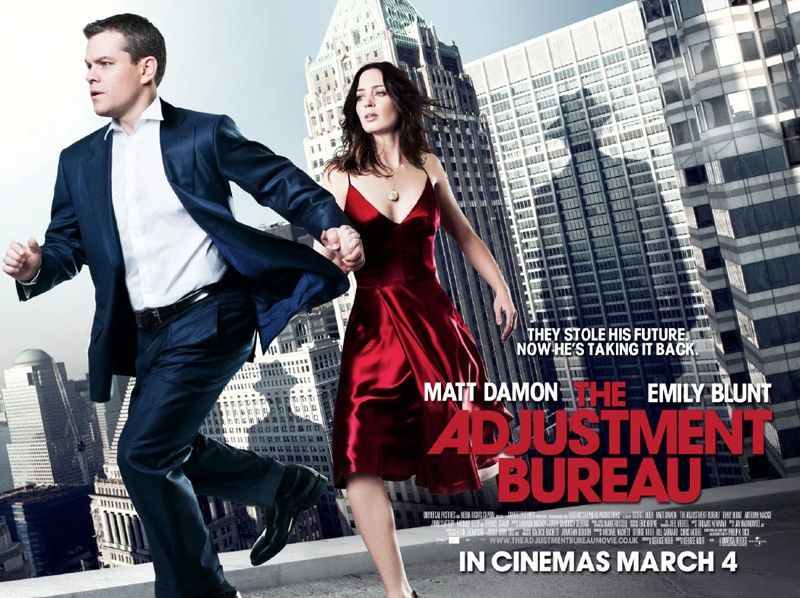
The Adjustment Bureau (2011)


"The Adjustment Bureau" centers around the age-old battle of predestination vs. free will. Are we really in control of our destinies, or has everything been laid out for us ahead of time? According to this film, it's a little bit of both... if we're willing to work for it.

The movie begins with a young politician named David Norris (Matt Damon) who, after a photo of him from his college party days surfaces in the tabloids, realizes he is losing in the New York senate race. As he's preparing to give his "I'll get back up after this" speech in the bathroom, he unexpectedly meets a stunning woman named Elise (Emily Blunt). Their meet-cute inspires him to give a rather honest speech about what goes into politics and the pursuit to be liked, which apparently comes down to details as minute as how shiny a person's shoes are. This essentially wins many people over, which suggests a promising future for Norris.

Some time after that, Norris winds up running into Elise again on a bus, where they exchange more flirty banter and she gives him her number. At this point, we become aware that the Adjustment Bureau does not want these two to be together -- and their running into each other again was a mistake. Anthony Mackie's character Harry was supposed to ensure Norris spilled coffee on himself and did not end up making that particular bus. Harry has been monitoring Norris' activities for what we can only guess has been a very long time. There is a strict plan for everyone, and it's the Adjustment Bureau's job to make sure everyone is on their correct path.


Because Norris catches that bus and arrives to work earlier than planned, he walks in on a behind-the-curtain look at the Adjustment Bureau, which is essentially "going to work" on his campaign manager. Confusion ensues, and Norris is told about the bureau and what they do. John Slattery plays Richardson, who initially leads the effort to get Norris back on track. He's a rather stern guy, and he tells Norris that if he tells anyone about the bureau, they will basically lobotomize him. Also, he is never to see Elise again, although they don't tell him why.

The movie goes on, and Norris rides the same bus everyday for three years in hopes of finding Elise again. See, the bureau has burned her number and will basically thwart any effort he makes to try and reach her. As chance would have it, he sees her walking on the sidewalk three years later and they rekindle their old spark.

Obviously, this upsets the bureau, and the rest of the film is a back-and-forth situation in which Norris employs every tactic possible to be with her and the bureau keeps pushing back.

Eventually the bureau brings out the big guns with a fellow named Thompson (played by Terence Stamp). He's a scary S.O.B. who doesn't put up with Norris' antics. He tells Norris that if he stays with her, he will never be successful politician and Elise will never be a famous, world-renowned ballerina. This seems to work on Norris. Oh, and Thompson further emphasizes his seriousness by causing Elise to fall and sprain her ankle during a dance practice.


Anyway, years later he finds out Elise is getting married to a guy she never really loved. This sends Norris over the edge and he is determined to win her back at any cost. With the help of Harry, he devises a plan to get to her and rewrite their "plan" before the bureau can catch on.

I must say, I enjoyed the film overall. I thought the chemistry between Blunt and Damon was believable, and the acting on both parts was enjoyable. There was wit, humor, suspense, intrigue and passion. I liked Harry's character, too.  Even though he worked for the bureau, you could see that he too questioned their activities. Who made these plans, and why? Ultimately I think that's why he helps Norris in the end.

I learned later that the movie was based on a short story, which made sense to me because I felt this film could have been shorter. It gets a bit muddled towards the middle. I enjoyed the sci-fi aspect to it, and I have always liked the dichotomy of choice/destiny. In the end *spoiler* we find out that the master plans are written by some God-like figure who runs the bureau (which I guess would mean the bureau agents are like angels...), but apparently if you're willing to risk everything to make your own choices, you somehow earn them. All that stuff was kind of odd and preachy, but I guess it had to wrap things up with some kind of Hollywood resolution.

Overall, it was a fun movie with a unique take on life.

-----------------


PG-13, 1 hr. 39 min.
Science Fiction & Fantasy, Romance
George Nolfi
George Nolfi

Jun 21, 2011
$62.5M
Universal Pictures

Sunday, December 4, 2011

All the President's Men (1976)

The most devastating detective story of the century!

As a journalist, I absolutely loved this movie. The story begins with Washington Post reporter Bob Woodward (Robert Redford), who covers what seems to be a minor break-in at the Democratic Party National headquarters... and what is later known as the Watergate Scandal. He is surprised to find out that the burglars already have top lawyers assigned to their case, and after finding several connections between the burglars and the Republican Party, he begins to unravel a lengthy trail of lies and corruption. Woodward, with the help of fellow reporter Carl Bernstein (Dustin Hoffman), follows a trail of money that leads higher and higher in the Republican Party and eventually to the White House itself in what is one of the biggest political scandals of all time.


What I enjoyed about this film was that it focused on how the story was obtained, giving us a true journalistic perspective. We are all familiar with President Nixon and the Watergate Scandal, but some people may not have known the lengths these reporters had to go to get the story. It also demonstrates journalism in its hay day, something that both excites and saddens me. 

Like a good news story, the movie did not include any fluff or subplot that wasn't key to the story, and there was no over-dramatization of the events. It seemed, at least to me, rather authentic and poignant. I thought Dustin Hoffman and Robert Redford played well off each other, particularly in the way their characters differed in pursuing the story. On that note, I don't know if it's just because I'm a reporter myself, but watching their interactions with the sources and how they went about coaxing information from these people who were obviously reluctant - and even scared - to talk was very interesting. I can imagine that it must have been challenging to get these people, who clearly were told by some pretty high-up officials not to talk to the media, to divulge. I particularly liked Bernstein's approach with the book keeper - when he went to her house for 6 hours and drank an exorbitant amount of coffee until he got what he needed. I also liked some of the craftier things they utilized to get their deep background information, like meeting in parking garages or telling one source to hang up the phone before the count of 10 if the information was incorrect. I personally have never gotten to use any of those tactics, but I can see the thrill of it when the situation calls for it. I also enjoyed their messy note-taking, which is exactly how it really is. Sometimes I can barely read my own notebooks.


Another thing that struck me was their gumption. The Washington Post was scrutinized and even slandered by important government officials for printing these stories, which for the most part did not have attributed sources. Later in the movie, their lives are even put at risk for pursuing such a damaging story. However, instead of backing down or printing any retractions, they pushed forward because they knew they had a story. They knew that in the end, they would be uncovering something so important that any struggles along the way would be worth it. I can only imagine how exciting that must have been for everyone involved. 

Watching this movie now, in 2011, I can see some stark contrasts between journalism then and now. The newsroom featured in the movie seemed quite sizable and filled with bustling activity. Most newsrooms today are about 1/4 that size and the number of employees is even smaller. I've only been in the industry for 3ish years, but I can say with certainty that those days are over. Now papers are just trying to find a way to stay relevant. I can't speak for the big league papers, which may still have the ample resources and abundant staff of the past, but most local dailies fall into the "not what we used to be" category.

Overall, it's an exceptional movie and a compelling account of what goes into unearthing such a powerful story. And even though we already knew where this information would inevitably lead, the viewer can't help but become just as excited as the reporters were with each new discovery.
  
-----------
 
PG, 2 hr. 18 min.
Drama, Mystery & Suspense, Classics
Synopsis: Reporters Woodward and Bernstein uncover the details of the Watergate scandal that leads to President Nixon's resignation.  
Alan J. Pakula
William Goldman

Oct 30, 1997
Warner Home Video

Sunday, September 18, 2011

Fight Club (1999)


 "How much can you know about yourself if you've never been in a fight?"

I first saw this film when I was in high school, and let's just say I went into a 'Fight Club' phase. No, I wasn't starting any underground fight clubs, but I immediately decided to read the novel by Chuck Palahniuk, and I became transfixed by its message.


For those of you who haven't gotten around to seeing it (which I highly recommend you consider), the film centers around Edward Norton's character (the nameless narrator), who has been suffering from severe insomnia.

 "When you have insomnia, you're never really asleep... and you're never really awake."

After taking his doctor's advice to witness more severe suffering, the narrator finally finds relief by attending support groups - whether it's for people diagnosed with testicular cancer, brain parasites or tuberculosis. The narrator becomes addicted to going to these meetings because they provide him with an emotional release that allows him to sleep at night.

"Strangers with this kind of honesty make me go a big rubbery one."

However, the problem occurs when the narrator notices a certain female has recently been attending all of his same support groups. Cue Marla Singer (played by the lovely Helena Bonham Carter). And yes, Marla even attends the testicular cancer group, which she claims to have more of a right to attending seeing as how the narrator still has his testicles. The narrator is no longer able to get the same satisfaction while knowing there is another faker present. So, they decide to split the groups up and alternate days.

Then, the narrator meets Tyler Durden. Quite an interesting character, Tyler seems to embody all the things the narrator wishes he could be. He's cool, he's confident, he's not attached to material things and he just doesn't seem to give a damn about societal standards. In fact, he despises them.

"The things you own end up owning you."

After the narrator's IKEA-furnished apartment unexpectedly blows up, he comes to live with Tyler. Long story short, they decide to start fight club. Surprisingly enough, it gets quite a following. Men from all walks of life flock to these underground battle royales, and it seems to mean something special for each one of them.

That's as far as I want to go with the storyline, though, because I don't want to spoil the ending. But I will say that the club becomes something much larger, and there is definitely a fun and unexpected twist at the end.

For those who do want to know the ending... *spoiler* we discover that all these unaccounted for time lapses are actually due to the fact that Tyler Durden is the narrator's alter-ego. He never existed, at least not as a separate person. The narrator became him while he thought he was sleeping. Tyler embodied all the traits the narrator wanted to encompass but was too afraid to. So, in the end, the narrator has to "kill" Tyler or be killed by Tyler. This never-having-existed twist was so mind blowing and original in its time. No one could have seen it coming.

What's interesting is that the film was panned by many critics when it originally came out, largely due to the high level of violence. Only later, after the movie had been released on DVD, did it gather a cult following (interestingly enough, several actual fight clubs were reported to have started in the U.S.). I think it's a mistake to think this movie is advocating violence or nihilism. If anything, it's a reflection of contemporary manhood. Fighting was the only way for them to experience feeling in a society where they are otherwise numb. There's one scene where Tyler and the narrator are on a bus and see a half-naked man on a Calvin Klein ad, and the narrator asks, "Is that what a man looks like?" Tyler responds with "Self-improvement is masturbation. Now self-destruction..."

Tyler Durden: Do you know what a duvet is?
Narrator:
It's a comforter.
Tyler:
It's a blanket. It's a fucking blanket. Now, why do guys like you and me know what a "duvet" is? Is this essential to our survival, in the hunter-gatherer sense of the word? No. What are we then?
Narrator:
Consumers...
Tyler:
We are the byproducts of a lifestyle obsession. Murder, crime, poverty, these things don't concern me. What concerns me are celebrity magazines, television with 500 channels, some guy's name on my underwear. Rogaine, Viagra, Olestra...
Narrator:
Martha Stewart...
Tyler:
Fuck Martha Stewart! Martha's polishing the brass on the titanic. It's all going down man! So fuck off with your sofa units, and string green stripe patterns.

'Fight Club' has an interesting take on modern culture and how advertising has essentially emasculated men and turned them into a society of spectators. Our material culture ultimately defines our external signifiers of happiness, while the more meaningful pursuit for spiritual happiness is neglected. At it's most basic level, the film is about a man who is trying to redefine his place in the world. 

"It's only after we've lost everything that we're free to do anything."


Edward Norton, Brad Pitt and Helena Bonham Carter were excellent choices, and all of them delivered exceptional performances. The movie also has some interesting visual effects that still blow me away to this day. There is something very cool about the way the movie has a dark look and feel, and I personally enjoy the special images spliced into a few of the scenes. And, although the movie has a slightly different ending, much of the storyline is very close to that of the novel.

The funny (and slightly sad) thing is, Fight Club's message still rings true to this day. As I sit here on this Super Bowl Sunday hearing a commercial for the Ritz Cracker Pre-Game Show, I can hear Edward Norton's voice in my head.... "When deep space exploration ramps up, it'll be the corporations that name everything... the IBM Stellar Sphere, the Microsoft Galaxy, Planet Starbucks."

But if asked, you didn't hear any of this from me, because the first rule of fight club is: you do not talk about fight club. 

-------

Genre: Drama, Comedy
Synopsis: An office employee and a soap salesman build a global organization to help vent male aggression.
Rated: R
Running Time: 2 hr. 20 min.
In Theaters: Oct 15, 1999 Wide
Distributor:
20th Century Fox
Directed By:
David Fincher
Written By:
Jim Uhls

Memento (2000)


"Some memories are best forgotten." 

Let me start off by saying that I think Christopher Nolan is a genius. This movie continues to intrigue, confuse, puzzle and entertain me, and I always seem to catch something new with every viewing  - which is truly the sign of a great film. 
What makes this film so impeccable is that its viewers have come up with so many different theories, themes and revelations about the actual Truth behind the film, and it is that Truth that the viewer and narrator are searching for from beginning to end. Any movie that keeps you thinking about it even days after you've seen it is worth closer inspection. 

The film begins at the end, so to speak, and works its way backward. The narrator and lead character is a former insurance investigator named Leonard Shelby, played by Guy Pearce. We learn that Shelby suffers from short-term memory loss. He can't make new memories after the night he received the head trauma that left him with anterograde amnesia. As he recalls, that was the night two men broke into his house, raping and killing his wife in the middle of the night. He walked into the bathroom to find his wife beneath his attacker, wrapped in a shower curtain. He managed to shoot one of the two men, but the other hit him from behind and got away. 

Ever since that night, however long ago it actually was, Leonard has made it his life's purpose to seek and kill the man who got away. He uses notes scribbled on polaroid photos and various tattoos all over his body to help him navigate his life. 

The movie moves backward from the moment he kills the man he believes raped and killed his wife to how it all began on that fateful night of his wife's death. 

However, as I sit here trying to write about this film, I am finding it hard to really give a synopsis because nothing in the movie is exactly as it appears to be. There are very few certainties. A lot of it is up for interpretation, which makes it all the more exciting. 

Throughout the film, Leonard often brings up the name Sammy Jankis, who he recalls was a man he had to investigate for possible medical insurance fraud. Sammy suffered from the same form of short-term memory loss, although there was a significant difference between Sammy and Leonard (as Leonard so often likes to point out) - Sammy was unable to condition himself. He could not learn something even if it were repeated the same way everyday, which Leonard says is something controlled by a different part of the brain. This led Leonard to believe that Sammy's condition was mental and not physical. This comes as a big blow to Mrs. Jankis, who seems to think she should be able to snap her husband out of his state. She tries a series of different tests to see how far she can push him, which ultimately leads to her final test. She, a diabetic, has Sammy re-administer her insulin shots repeatedly, each time setting back the time on her watch, to see if he would really let her die. Unbeknownst to Sammy, that is exactly what happens. 

Tattooed on Leonard's left hand are the words "Remember Sammy Jankis." I believe this was a way to motivate himself to live a life with purpose and action, rather than Sammy's life of meaninglessness. Leonard was constantly driven to find his wife's killer and bring him to justice. It gave him purpose and meaning, even if it would be a justice he wouldn't remember the next day.


We quickly find out that the people supposedly helping him over the last few days are not pure in motive. Natalie, played by Carrie-Anne Moss, and Teddy, played by Joe Pantoliano, are using Leonard for their own personal means and neither are truly upfront about their identities.

The movie plays with the concept of memory. Leonard lives his life based on what he believes are facts and absolute truths. 


Leonard: Memory can change the shape of a room; it can change the color of a car. And memories can be distorted. They're just an interpretation, they're not a record, and they're irrelevant if you have the facts.

As the film goes on, we begin to doubt Leonard's so-called facts. Things aren't as they initially seemed. And in the end, we find out that the truth is more than anyone bargained for. 

What also sets this film apart is how it is laid out. We have to piece the puzzle together just as Leonard does, relying on jotted notes and fragmented time. If played backward, the movie would run in chronological order, but what would be the fun in that? This progression, digression, progression sort of flow added a dimension to the film that really took it to the next level.


For those who have seen the film.... 


In the end, we discover that Leonard has indeed already found and killed his wife's tormentor, according to Teddy, who is trying to snap Leonard out of it. We also learn that Leonard's wife was the one with diabetes, and he was the one who overdosed her with insulin. The story begins to fall into place, or unravel, depending on your point of view. 

Leonard doesn't seem to want to believe all of this, and he can't seem to remember his wife having diabetes for sure, or killing his wife's aggressor, although Teddy has a picture of Leonard in extreme bliss, pointing to the spot on his chest reserved for the tattoo saying he finally did it. 

You are left questioning just about everything. 

Then it gets even more unexpected. Leonard essentially sets into motion a set of clues and "facts" that will lead him to the conclusion later on that Teddy is his wife's killer and the man he has been looking for all this time. He takes down Teddy's license plate number and marks it down as a "fact" and writes "Don't believe his lies" on the back of his polaroid. We realize that Leonard would rather live in this perpetual state of hunting for justice than facing the fact that he has already accomplished it and - possibly - face the realities of what he has done. Maybe he also doesn't want to live a life like Sammy Jankis, without purpose.

I have read up on so many different theories and questions that still plague viewers. Was there ever really a Sammy Jankis? Why did Leonard put on Jimmy's suit? Was Teddy telling the truth about Leonard's wife being the one with diabetes? Was all this just a way for Leonard to cope with the fact that he killed his wife? Had Leonard escaped from an insane asylum? Where did the name John/Jimmy G. even originate? Was Leonard's condition mental or physical? Was his wife still alive?

The joy is, I don't think we will ever know for sure. 


----------
R, 1 hr. 56 min.
Mystery & Suspense, Drama
Synopsis: A man, suffering from short-term memory loss, uses notes and tattoos to hunt for the man he thinks killed his wife.  
Christopher Nolan
Christopher Nolan, Jonathan Nolan

Sep 4, 2001
$23.8M
Newmarket Films

Tuesday, April 5, 2011

Ten Inch Hero (2007)

I'll admit - the only reason I watched this was for Jensen Ackles (star of my favorite television show "Supernatural"). However, I am really glad I did because it was very very cute.

"Ten Inch Hero" centers around a quirky group of individuals who work at a sandwich shop in Santa Cruz and each of their unique love lives. The main character, Piper (Elisabeth Harnois), is new to join the crew. A young artist, Piper later reveals that she moved to Santa Cruz to be closer to her young daughter, whom she gave up for adoption and has lost contact with for several years. The family that adopted Piper's daughter, Julia, ceased communicating with Piper after two years. After finidng a newspaper clipping about a talented young youth who has a gift for art and also shares the same name as her daughter, Piper packed up and moved to California. She begins innocently stalking the family (although it's just the dad and daughter at this point) until she fatefully finds herself being part of their lives.

The other members of the sandwich crew are also going through important stages of their lives - mostly in the love department. Priestly (Jensen Ackles) is the off-beat, tattoeed and peirced, yet charming, cook with a mohawk that changes colors almost daily. After years of seeing how women choose the men they will date based solely on looks, he has become disillusioned by love. Jen (Clea DuVall) is the smart and kind-hearted woman who works the computers. She has been engaging in an online relationship with an anonymous person she met online. She fears the inevitable day when they will have to meet face-to-face. Tish (Danneel Ackles) is the sexy vixen who can get any guy who walks into the sandwich shop. However, she has a tendency to pick all the wrong guys, later realizing looks are not the best indicators for a man's character. Lastly, Trucker (John Doe) is the surfer/hippy shop owner who has been pining after the free-spirited woman who works across the street. However, he just can't seem to make the first move.

All in all, this movie has some pretty universal themes: things aren't always as they seem, don't be fooled by appearances, beauty is only skin deep, don't judge a book by it's cover, etc. However, the movie has an interesting way of making these timeless themes fresh and still relevant. Each character has a different issue to face, but in the end, it all comes back to love and identity. Priestly helps show Tish that perhaps if she stopped picking guys based on physical appearance, she may end up finding the man of her dreams. Jen learns that even though she was quick to assume her internet-penpal (who turned out to be a looker) would probably judge her negatively based on her seemingly average looks, she was also negatively judging him without actually giving him a chance. Piper, whose story line was actually my least favorite and much less believable, learns some things too but I'm not really going to get into it. Overall, there is more to people than meets the eye, and if you take the time to realize that, you will reap the benefits (wouldnt it be great if we could all end up with a sweet and caring guy who also looks like Jensen Ackles?).

"Ten Inch Hero" is a cute and enjoyable movie, and I have a feeling I'll be watching it again at some point. What's great about it is that I think out of all the characters, there is at least one that each one of us can directly relate to. I highly reccomend!

--------------

Genre: Drama, Comedy
Synopsis: The story of five friends who learn about love, sex, and cold cuts while working in a funky sandwich shop.
Rated: R
Running Time: 1 hr. 41 min.
On DVD: Feb 22, 2011
Distributor:Phase 4 Films
Directed By: David MacKay , David Mackay

Sunday, April 3, 2011

Limitless (2011)

This movie made me wish that NZT was a real drug. 

"Limitless" is the story of a struggling writer named Eddie Morra (Bradley Cooper) who is generally lacking in ambition and any real direction in life. His girlfriend leaves him and the book he has been "working on" for the past several years doesn't actually have a word on the page yet. Anyway, Eddie runs into an old acquaintance on the street -- his ex-brother-in-law. The former deadbeat seems to have his life together and informs Eddie that its all thanks to this brand new drug that hasn't hit the market yet. He lets Eddie try one on the house and Eddie soon discovers that this mysterious pill, which they call NZT, has some pretty incredible effects. The pill allows you to use all of your brain -- anything you've ever read or heard in your lifetime can be accessed instantly like you were pulling an old file from the shelf. You can become fluent in a new language within hours, think your way out of life-threatening situations, or in Eddie's case, you can write that book you've been sitting on for years in the course of a few days. 

Of course, there are downsides to the miracle drug. Eddie finds out that those who used to take the drug are either dead or have serious mental illnesses. Eddie, who has been taking the drug more frequently now and has come into quite a different lifestyle as a high-powered consultant in the financial world, finds himself unable to account for what he's been doing during periodic blackouts that sometimes last for hours. Eddie also finds that his life is in danger. The drug, obviously in high demand by those who know about it, drives some to go to great lengths to ensure they can get it.

In the middle of all of this, Eddie makes the acquaintance of business mogul Carl Van Loon (Robert De Niro), who he manages to impress with his new-found business insight. However, things become much more complicated as Eddie fights for survival -- both against the drug's fatal effects and the hit-men who are trying to kill him. 

It's a great action-thriller. Very entertaining and it really showcases Bradley Cooper's acting ability. I didn't know for sure if Cooper would be able to carry an entire film as the lead, but he did. Most of the films I've seen him in have been comedies where he performs with a strong ensemble cast. But "Limitless" proves that there is more to Mr. Cooper than just good looks and witty quips. The man has some range.

It also makes you consider what you could accomplish if you had the chance to sample some NZT. As a writer, I often find myself suffering from the painful debilitation of writer's block. Just the other day I thought to myself "If only I had just one of those small, clear pills..."

And for those who have seen the film, I am interested to know what you thought of the end. Eddie's claim that he successfully weaned himself off the drug with no side effects yet he was still able to retain everything he learned seems highly debatable. The way the ending was depicted, I think that was the director's intention. I don't think we are supposed to know for sure.

---------------
Genre: Mystery & Suspense, Science Fiction & Fantasy
Synopsis: A writer discovers a top-secret drug which bestows him with super human abilities.
Rated: PG-13  
Running Time: 1 hr. 45 min.
In Theaters: Mar 18, 2011 Wide
Box Office:$41.1M
Distributor: Relativity Media
Directed By: Neil Burger